FAUN.dev's Programming Weekly Newsletter
🔗 View in your browser | ✍️ Publish on FAUN.dev | 🦄 Become a sponsor
🔗 View in your browser | ✍️ Publish on FAUN.dev | 🦄 Become a sponsor

VarBear
#SoftwareEngineering #Programming #DevTools
📝 A Few Words
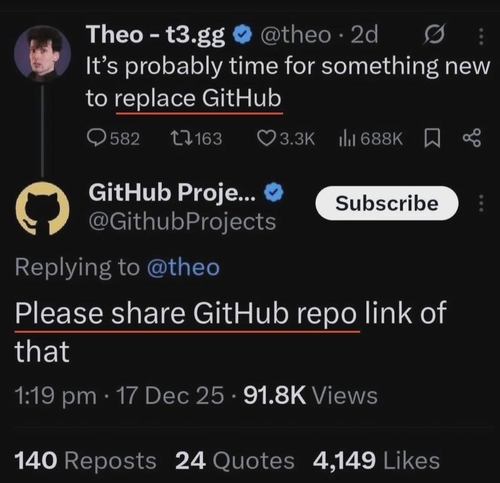
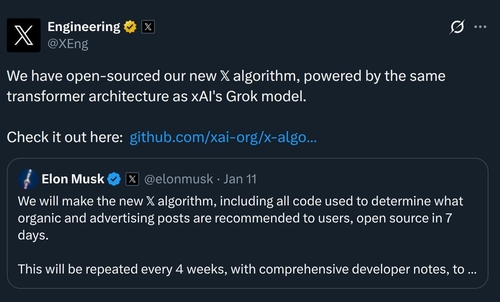
X open-sourced their new algorithm..
I'm not that curious but the only thing I know about the X algorithm is that I see Elon Musk’s posts on my timeline more than my own thoughts.
Open-sourced? Great!! Transparent? Love it!!! Transformer-based? Of course!!!!
But from my user side, the model seems simple:
Maybe the real ranking signal is just: if user == human: boost elon.
Jokes aside, this is the funniest part of "algorithm transparency" in practice: you can publish all the code you want, but the lived experience is still the metric everyone notices first.
Have a great week!
Aymen
I'm not that curious but the only thing I know about the X algorithm is that I see Elon Musk’s posts on my timeline more than my own thoughts.
Open-sourced? Great!! Transparent? Love it!!! Transformer-based? Of course!!!!
But from my user side, the model seems simple:
- Input: Open app
- Hidden layer: Elon tweets
- Output: More Elon tweets
Maybe the real ranking signal is just: if user == human: boost elon.
Jokes aside, this is the funniest part of "algorithm transparency" in practice: you can publish all the code you want, but the lived experience is still the metric everyone notices first.
Have a great week!
Aymen
🔍 Inside this Issue
From GPU-sharp ASCII art and Rust ripping out Protobuf for raw speed to the AT Protocol turning social into a filesystem, this batch toggles between elegant primitives and messy realities. We also hit Go's trust gap with AI, Gen Z's agent-flavored future, and the security footguns hiding in code assistants, so dive in for the details.
🎨 ASCII characters are not pixels: a deep dive into ASCII rendering
🗂️ A Social Filesystem
🐹 Go Developer Survey Is Out: What 5,379 Go Developers Actually Want Next
🧭 If you're a Zoomer, this one's for you: Everything Gen Z needs to know about the 2025 tech landscape
⚙️ Replacing Protobuf with Rust to go 5 times faster
🔒 YOLO Mode: Hidden Risks in Claude Code Permissions
Ship faster, stay safer.
See you in the next issue!
FAUN.dev() Team
🎨 ASCII characters are not pixels: a deep dive into ASCII rendering
🗂️ A Social Filesystem
🐹 Go Developer Survey Is Out: What 5,379 Go Developers Actually Want Next
🧭 If you're a Zoomer, this one's for you: Everything Gen Z needs to know about the 2025 tech landscape
⚙️ Replacing Protobuf with Rust to go 5 times faster
🔒 YOLO Mode: Hidden Risks in Claude Code Permissions
Ship faster, stay safer.
See you in the next issue!
FAUN.dev() Team
ℹ️ News, Updates & Announcements
faun.dev
The 2025 Go Developer Survey is in - and AI’s gaining ground. Devs are leaning on it for unit test scaffolding, autocompletion, and similar grunt work. But trust? Still shaky. Quality’s not there yet.
Elsewhere, they’re bumping into old problems: core tools still hard to navigate, non-idiomatic code patterns still causing trouble, and a rising call for clearer best practices and better trust signals in modules.
Elsewhere, they’re bumping into old problems: core tools still hard to navigate, non-idiomatic code patterns still causing trouble, and a rising call for clearer best practices and better trust signals in modules.
🔗 Stories, Tutorials & Articles
stackoverflow.blog
If you're a Zoomer, this one's for you: Everything Gen Z needs to know about the 2025 tech landscape
AI investment hit $1.5T in 2025. Think dot-com energy: bloated valuations, feverish M&A. Startup acquisitions shot up 13%. Deal volume? Up 115%.
Hype’s worn thin. Enterprises are done lighting money on fire with flashy tools. Focus is shifting to agents - LLMs that do things, not just say things.
System shift: Developer workflows are crawling toward agent-based stacks. But LLM non-determinism and lack of trust are killing momentum.
Coding practices are splintering. "Vibe coding" - AI generating entire chunks of code - lets non-devs play dev. But it’s messy. Bugs get weirder. Debugging feels like psychic work. Trust in AI tools is breaking. Engineer confidence, too.
Junior hiring slid 25%, but Gen Z devs are crushing it with AI tools. Employers are rethinking “experience” as the resume gold standard.
Elsewhere, 2025 broke some serious ground. Google’s Willow chip leveled up quantum error correction. OpenAI, Adobe, and Microsoft aligned on C2PA watermarking for AI images. Stargate - the $500B datacenter fortress in Texas - went live with 50K NVIDIA Blackwell chips.
Hype’s worn thin. Enterprises are done lighting money on fire with flashy tools. Focus is shifting to agents - LLMs that do things, not just say things.
System shift: Developer workflows are crawling toward agent-based stacks. But LLM non-determinism and lack of trust are killing momentum.
Coding practices are splintering. "Vibe coding" - AI generating entire chunks of code - lets non-devs play dev. But it’s messy. Bugs get weirder. Debugging feels like psychic work. Trust in AI tools is breaking. Engineer confidence, too.
Junior hiring slid 25%, but Gen Z devs are crushing it with AI tools. Employers are rethinking “experience” as the resume gold standard.
Elsewhere, 2025 broke some serious ground. Google’s Willow chip leveled up quantum error correction. OpenAI, Adobe, and Microsoft aligned on C2PA watermarking for AI images. Stargate - the $500B datacenter fortress in Texas - went live with 50K NVIDIA Blackwell chips.
upguard.com
A scrape of 18,470 Claude Code configs on GitHub shows a pattern: developers are handing their AI agents the keys to the castle.
Unrestricted file, shell, and network access is common. Among them:
- 21.3% let Claude run curl
- 14.5% allow arbitrary Python execution
- 19.7% give it git push privileges
That’s how a prompt injection turns into full-blown RCE or a supply chain breach.
Unrestricted file, shell, and network access is common. Among them:
- 21.3% let Claude run curl
- 14.5% allow arbitrary Python execution
- 19.7% give it git push privileges
That’s how a prompt injection turns into full-blown RCE or a supply chain breach.
alexharri.com
A fresh take on programmatic ASCII rendering brings in high-dimensional shape vectors, supersampling, and contrast tricks to keep edges crisp and animations clean. Under the hood: k-d tree nearest-neighbor lookups, vector quantization, and GPU-powered sampling help push sharp ASCII frames without tanking performance.
overreacted.io
The AT Protocol flips social apps inside out. Instead of locking posts and profiles inside platform silos, it treats them as files - JSON-based records, stored in your own decentralized, app-neutral repo.
Everything you do - posts, follows, likes - gets logged as a signed, timestamped record in your personal namespaced collection. It's all tied to your DID (Decentralized Identifier), which doesn’t break if the host or domain ever changes.
Everything you do - posts, follows, likes - gets logged as a signed, timestamped record in your personal namespaced collection. It's all tied to your DID (Decentralized Identifier), which doesn’t break if the host or domain ever changes.
pgdog.dev
PgDog ditched Protobuf for raw C-to-Rust integration in pg_query.rs. The new setup uses bindgen and recursive FFI wrappers - no serialization, no handoffs.
The payoff? Query parsing is 5× faster. Deparsing hit 10×. Even pgbench saw a 25% bump across major ops.
The payoff? Query parsing is 5× faster. Deparsing hit 10×. Even pgbench saw a 25% bump across major ops.
💬 Discussions, Q&A & Forums
philosophy.stackexchange.com
Suppose one takes a screenshot of a digital picture (for example, an image displayed on a screen). Is the screenshot the same picture as the original, or is it a distinct picture that merely represents the same content?
⚙️ Tools, Apps & Software
github.com
Complete Claude Code configuration collection - agents, skills, hooks, commands, rules, MCPs. Battle-tested configs from an Anthropic hackathon winner.
github.com
A colorful interactive physics simulator with thousands of balls, but in your terminal!
github.com
Multi-platform SDK for integrating Copilot Agent into apps and services
🤔 Did you know?
Did you know that the Linux kernel limits eBPF tail calls to about 32 per packet so that one program can jump to at most 32 others? If a tail call runs out of gas or the target isn’t in the program array, it just falls back and keeps executing the current program. This bound comes from safety limits in the verifier and stack constraints, so complex eBPF datapaths have to organize logic carefully into a few larger programs rather than long chains of tiny ones.
🤖 Once, SenseiOne Said
"Convention over configuration moves configuration into naming and directory layout; the rule isn't in your repo. If you can't set it explicitly, you'll learn it from a failing build."
SenseiOne
SenseiOne
⚡Growth Notes
When you debug, rebuild only the smallest repro you can craft by hand, even if the main system is already running and "just logging more" would feel quicker. The engineers who quietly sketch stripped-down test code like this, refine it until it captures the real failure, and then keep those tiny repros as a personal diagnostic library end up seeing classes of bugs repeat instead of fighting isolated incidents.
👤 This Week's Human
This week, we’re highlighting Yusuf Aytaş, Senior Engineering Leader at Workday, who has led SRE, data science and engineering, backend, and platform engineering teams across EMEA, APAC, and North America. He writes the Software Engineering Handbook and lectures at Dublin Business School, distilling lessons from running systems on AWS, GCP, Azure, Kubernetes, Kafka, Spark, PostgreSQL, and Cassandra.
😂 Meme of the week