FAUN.dev's DevOps / SRE / Platform Engineering Weekly Newsletter
 🔗 View in your browser. | ✍️ Publish on FAUN.dev | 🦄 Become a sponsor

DevOpsLinks
This week in DevOps, with Dolly the Cow
📝 A Few Words
Everyone’s chasing scale this week—from OpenAI’s desert-sized data campus to Lyft automating away tech debt at warp speed. Meanwhile, Terraform loops are tripping up devs, and Kubernetes job trends just got... complicated.
👷 5 CI/CD Practices That Can Cut Your Deployment Time from 5 Hours to 5 Minutes
🔁 Terraform Loops Explained: Using count, for_each, and Advanced Patterns
🤖 Enhancing Ansible Lint with OpenAI: Writing Your Own Custom Rule
🌴 OpenAI to help UAE develop one of world's biggest data centers
💸 Microservices Are a Tax Your Startup Probably Can’t Afford
🧙 How to enhance your application resiliency using Amazon Q Developer
🧵 Tales from the cloud trenches: The Attacker doth persist too much, methinks
📉 The state of Kubernetes jobs in 2025 Q1
🧰 From manual fixes to automatic upgrades — building the Codemod Platform at Lyft
🔍 Identifying Hidden Cloud Waste in Your Code
Stack smart. Automate wisely. Ship better.
👷 5 CI/CD Practices That Can Cut Your Deployment Time from 5 Hours to 5 Minutes
🔁 Terraform Loops Explained: Using count, for_each, and Advanced Patterns
🤖 Enhancing Ansible Lint with OpenAI: Writing Your Own Custom Rule
🌴 OpenAI to help UAE develop one of world's biggest data centers
💸 Microservices Are a Tax Your Startup Probably Can’t Afford
🧙 How to enhance your application resiliency using Amazon Q Developer
🧵 Tales from the cloud trenches: The Attacker doth persist too much, methinks
📉 The state of Kubernetes jobs in 2025 Q1
🧰 From manual fixes to automatic upgrades — building the Codemod Platform at Lyft
🔍 Identifying Hidden Cloud Waste in Your Code
Stack smart. Automate wisely. Ship better.
⭐ Patrons
bytevibe.co
kubectl
Because chaos needs a commander.
Wear the command. Control the storm. ☁️💀
Because chaos needs a commander.
Wear the command. Control the storm. ☁️💀

ℹ️ News, Updates & Announcements
reuters.com
OpenAI plans to help develop a massive new data center in the United Arab Emirates that may eventually be one of the largest in the world, Bloomberg News reported on Friday. The ChatGPT maker is expected to be one of the primary anchor tenants for a 5-gigawatt data center campus in Abu Dhabi, the report said, citing people familiar with the matter.
news.itsfoss.com
Microsoft just dropped the KB5058385 patch and—hallelujah—it solves the nine-month Secure Boot nightmare. But hold your cheers, Linux dual-booters. You're still stuck in no-man's land.
kube.careers
North American Kubernetes salaries took a 6% nosedive, settling at an average $165,288. Meanwhile, Europe enjoyed a tidy 4% uptick. Remote work? Holding steady at 68%. No surprise—Python remained the darling of coding languages, getting a nod in 62% of job posts, while Docker wasn't far behind, gracing 57% of openings.
siliconangle.com
Linux Foundation drops a global Cybersecurity Skills Framework to battle the talent drought. It links skills to heavyweights like DoD Directive 8140.
🐾 From FAUNers
faun.pub
Terraform's meta-arguments, count and for_each, work loop magic. But tread carefully—these two have quirks. Lists or maps? Makes a difference. Mess up, and resources might just do the cha-cha instead of staying put.
faun.pub
What started as a simple front-end bug fix turned into a 5-hour odyssey through an insanely tangled CI/CD pipeline. In the end, cutting clutter and automating the mess saved the day.
faun.dev
OpenAI inspector for Ansible allows users to inspect their Ansible code using AI-based rules. By installing ansible-lint and following a few commands, users can utilize pre-built rules or create their own to ensure their Ansible tasks and playbooks adhere to best practices. Using OpenAI, users can analyze their Ansible code with more contextual information to enhance the inspection results.
⭐ Sponsors
faun.dev
Have a blog post or a useful link to share? Contribute on FAUN — the platform built by and for developers.
🛠️ Write in Markdown
Use your favorite format — clean, simple, and developer-friendly.
📣 Why Post on FAUN?
✅ Easy editor
✅ Free exposure
🚀 Start sharing your insights today → faun.dev
🛠️ Write in Markdown
Use your favorite format — clean, simple, and developer-friendly.
📣 Why Post on FAUN?
- Get featured in our newsletters
- Reach tens of thousands of developers
- Boost your visibility in the dev world
✅ Easy editor
✅ Free exposure
🚀 Start sharing your insights today → faun.dev

🔗 Stories, Tutorials & Articles
uptimelabs.io
AI-driven incident management holds great promise, but what happens when AI fails? Engineers risk losing critical system understanding as AI takes over routine tasks, highlighting the need for human oversight and collaboration in this AI-enhanced future.
www.datadoghq.com
Postmortem Optimization: Slashing LLM costs while preserving quality and safety. Who said AI can’t spruce up even the most mind-numbing tasks?

aws.amazon.com
Amazon Q behaves like a tech-savvy wizard, dialing up app resilience with style. It champions Multi-AZ deployments, elastic scaling, and caching to strengthen AWS fortresses. With a talent for real-time failure analysis and savvy DR strategies, it transforms basic setups into systems that laugh in the face of chaos.
nixcademy.com
Nix shatters the myth that security demands clunky, air-gapped setups. It's a wizard at crafting reproducible, secure builds without dragging down speed or flexibility. Regulators can rest easy with Nix's "source closure" magic trick: full offline rebuilds and rock-solid supply chain integrity, all wrapped up in a tidy, no-nonsense package.
blog.railway.com
Mapping hardware to Linux device names? Chaos. Enter SystemD: its magic cleans up the network interface mess. Storage naming, though? Serial numbers rule the roost. With the sharp combo of Redfish HTTP API and Pixiecore, they revamped server setup. Price tag? A jaw-dropping under $1 for 50 servers. Thank a cunning AI-gRPC cocktail for that.
nexo.sh
Premature microservices are like planting seeds in concrete. They'll stall your startup's momentum. A monolith is your friend here—simple, reliable, with the vast realm of open-source at your disposal. A crisp monorepo tightens team synergy and sidesteps the quagmire of complexity, unlike those headache-inducing setups that derail you before you've even gotten started.
eng.lyft.com
Lyft's Codemod Platform turns chaos into calm. It converts disruptive updates into a few quick fixes, slashing manual review time for over 100 frontend microservices. Adoption rates rocketed by up to 30% in two weeks. They wield jscodeshift like a wizard's wand—transforming multiple languages and integrating smoothly, slicing through the work hours and keeping their codebase fresh. In a year, they've crafted over 40+ transforms. Not bad for a turbocharged kit of magic tricks.
techcommunity.microsoft.com
Azure Sentinel deployment now tightens security through CI/CD using Terraform and Azure DevOps. Say goodbye to those clunky manual setups. Hello, sleek automation.
www.windriver.com
StarlingX tackles low-latency like a boss, perfect for edge and enterprise clouds. It weaves together real-time Linux and OVS DPDK, all while juggling up to 5,000 nodes. It scales effortlessly, sprinting from humble single-node setups to sprawling tens-of-thousands in multi-region clouds. Timing precision? Sub-microsecond for those high-stakes apps.
fasterthanli.me
K3s reconciler threw a fit. A botched YAML reformat doubled up resources and obliterated the author’s cluster, courtesy of the clumsy hands of language models. It’s a vivid postcard from the island of LLM limitations. Luckily, Hetzner’s system rebuild stepped in to save the day. But it wasn’t painless. A delicate disaster recovery waltz ensued, uncovering Kubernetes' eccentric treatment of persistent volumes. Sometimes, tech quirks are just a too-friendly reminder of all that can go wrong.
securitylabs.datadoghq.com
Hackers snagged some leaked AWS keys and conjured up a "persistence-as-a-service" scheme. They weaved through API Gateways and Lambda like ghostly threads. Dodging revocation? Easy. They whipped up dynamic IAM users faster than you can say "security breach." Telegram buzzed with ConsoleLogin events—automation winked in the shadows. They fiddled with SSO and MFA settings, stretching session durations to sidestep pesky security controls. A digital tightrope walk, if there ever was one.
engineering.doit.com
Vadim Solovey blows the whistle on our love affair with so-called "efficient" code. It's smoke and mirrors, he insists. Behind the illusion lurk costly inefficiencies. Solovey demands we shift focus—ditch those endless cloud tweaks for something deeper: code-level fixes.
Enter execution profiling and cloud monitoring tools. These are your sleuths for unmasking memory bloat and sluggish queries. The fix? Refactor those tired algorithms, whip your data structures into shape. The reward? A headline-worthy 70% cut in processing time and resource drain. Now that's efficiency.
Enter execution profiling and cloud monitoring tools. These are your sleuths for unmasking memory bloat and sluggish queries. The fix? Refactor those tired algorithms, whip your data structures into shape. The reward? A headline-worthy 70% cut in processing time and resource drain. Now that's efficiency.
⚙️ Tools, Apps & Software
github.com
Take a list of domains, crawl urls and scan for endpoints, secrets, api keys, file extensions, tokens and more
github.com
JumpServer is an open-source Privileged Access Management (PAM) tool that provides DevOps and IT teams with on-demand and secure access to SSH, RDP, Kubernetes, Database and RemoteApp endpoints through a web browser.
🤔 Did you know?
Did you know that Stack Overflow runs on a surprisingly lean tech stack powered by C#, .NET, and SQL Server? Despite handling over 100 million visits a month, the site is so well-optimized that it runs on fewer than 10 web servers. The engineering team focuses heavily on performance tuning and efficient database queries—some pages render in under 15 milliseconds. It’s a prime example of how deep expertise in optimization can outpace sheer infrastructure scale.
🗣️ Quote of the week
It always takes longer than you expect, even when you take into account Hofstadter's Law ~ Hofstadter's Law
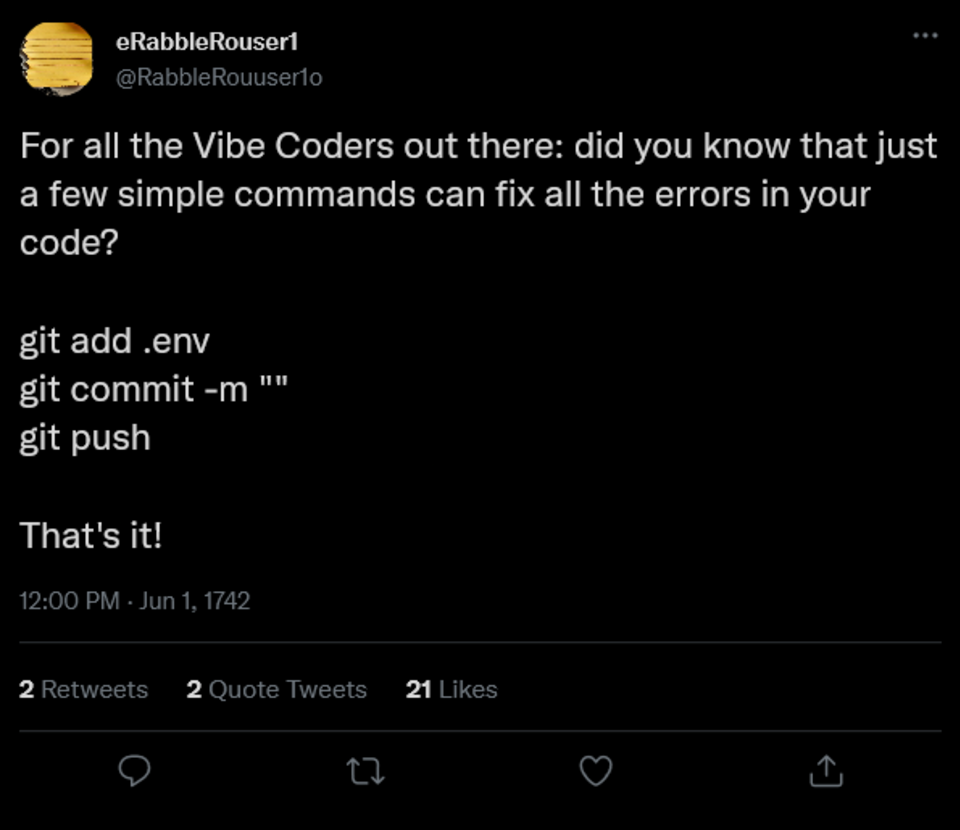
😂 Meme of the week