FAUN.dev's Software Engineering Weekly Newsletter
 
🔗 View in your browser   |  ✍️ Publish on FAUN.dev   |  🦄 Become a sponsor
 
Allow loading remote contents and showing images to get the best out of this email.
 
SoftwareEngineeringLinks
 
This Week in Software Engineering, with Varbear the Bear
 
 
🔍 Inside this Issue
 
 
Slack is untangling notification chaos while the Python docs world gets a nasty reminder that packaging and maintainership are part of your threat model. On the flip side, there are a couple genuinely interesting bets on how we write and run code next: monitored agents, and Python that can distribute work without turning into a framework.

🔔 How Slack Rebuilt Notifications
🧭 How we monitor internal coding agents for misalignment
📦 The Slow Collapse of MkDocs
🧶 What if Python was natively distributable?
🟦 Why I Vibe in Go, Not Rust or Python

Steal the ideas, dodge the pitfalls, ship the week.

Stay safe out there.
FAUN.dev() Team
 
 
🔗 Stories, Tutorials & Articles
 
medium.com medium.com
 
What if Python was natively distributable?
 
 
The Python ecosystem's insistence on solving multiple problems when distributing functions has led to unnecessary complexity. The dominant frameworks have fused orchestration into the execution layer, imposing constraints on function shape, argument serialization, control flow, and error handling.

Wool takes a different approach by allowing execution to be distributed without the need for DAG definitions, checkpointing, or retry logic, focusing on simplicity and transparency. Wool provides distributed coroutines and async generators that enable transparent execution on remote worker processes while maintaining the same semantics as local execution.
 
 
lifelog.my lifelog.my
 
Why I Vibe in Go, Not Rust or Python
 
 
In a world where the machine writes most of the code, Python lacks solid type enforcement, Rust is overly strict with complex lifetimes, while Go strikes the right balance by catching critical issues without hindering development velocity.

The article argues in favor of Go over Python and Rust for AI-generated code due to Go's efficiency, simplicity, clear error-handling, and easy deployment capabilities.
 
 
fpgmaas.com fpgmaas.com
 
The Slow Collapse of MkDocs
 
 
On March 9, 2026 a former maintainer grabbed the PyPI package for MkDocs. The original author's rights got stripped. Ownership snapped back within six hours.

Core development stalled for 18 months. Material for MkDocs went into maintenance. The ecosystem splintered into ProperDocs, MaterialX, and Zensical. Zensical leads in stars.
 
 
openai.com openai.com
 
How we monitor internal coding agents for misalignment
 
 
AI systems are acting with more autonomy in real-world settings, with OpenAI focusing on responsibly navigating this transition to AGI by building capable systems and developing monitoring methods to deploy and manage them safely. OpenAI has implemented a monitoring system for coding agents to learn from real-world usage, identify risks, and improve safety as AI capabilities progress. The system reviews agent interactions, alerts for problematic behavior, and surfaces potential issues for human review to mitigate consequences and improve agent security.
 
 
slack.engineering slack.engineering
 
How Slack Rebuilt Notifications
 
 
At Slack, notifications were redesigned to address the overwhelming noise issue by simplifying choices and improving controls. The legacy system had complex preferences that made it difficult for users to understand and control notifications. Through a collaborative effort, the team refactored preferences, implemented global settings, and achieved cross-platform parity to create a more cohesive and manageable notification experience.


👉 Got something to share? Create your FAUN Page and start publishing your blog posts, tools, and updates. Grow your audience, and get discovered by the developer community.

 
⚙️ Tools, Apps & Software
 
github.com github.com
 
saifyxpro/HeadlessX
 
 
The undetected self-hosted browser automation platform. Powered by Camoufox (Firefox) for 0% detection rates. Built for speed, privacy, and scalability.
 
 
github.com github.com
 
pubkey/rxdb
 
 
A fast, offline-first, reactive database for JavaScript Applications
 
 
github.com github.com
 
NousResearch/hermes-agent
 
 
The agent that grows with you
 
 
github.com github.com
 
Crosstalk-Solutions/project-nomad
 
 
Project N.O.M.A.D, is a self-contained, offline survival computer packed with critical tools, knowledge, and AI to keep you informed and empowered—anytime, anywhere.
 
 
github.com github.com
 
jnv/lists
 
 
The definitive list of lists (of lists) curated on and elsewhere


👉 Spread the word and help developers find and follow your Open Source project by promoting it on FAUN. Get in touch for more information.

 
🤔 Did you know?
 
 
Did you know that SQLite's WAL (Write-Ahead Logging) mode - its fastest and most concurrent journal mode, allowing readers and writers to proceed simultaneously - has a hard requirement that all database processes share the same host machine? WAL maintains a data structure called the wal-index in shared memory (via a memory-mapped -shm file) so readers can locate pages in the write-ahead log without scanning the whole file. Because shared memory cannot cross machine boundaries, the SQLite docs state plainly that WAL does not work over a network filesystem - if the VFS cannot provide shared-memory primitives, the PRAGMA journal_mode=WAL call silently falls back to the previous journal mode rather than enabling WAL. This makes the most performant SQLite configuration also the least portable one.
 
 
🤖 Once, SenseiOne Said
 
 
"Every dev tool promises to remove friction, then quietly adds a new surface area you have to reason about under pressure. The only stable productivity gain is the part of the stack you can explain, not the part you can automate."
- SenseiOne
 

(*) SenseiOne is FAUN.dev’s work-in-progress AI agent

 
⚡Growth Notes
 
 
Docs that live in the same repo as the code but outside the PR review checklist decay at the same rate as commented-out dead code - the implementation moves, the doc stays, and the next engineer loses an hour not because the feature is complex but because the written contract describes a version that no longer exists.
 
Each week, we share a practical move to grow faster and work smarter
 
👤 This Week's Human
 
 
This week, we’re highlighting Dirceu Vieira Junior, a Senior Software Engineer at iFood and 7x Salesforce Certified full stack developer with 10+ years in software. Formerly a Salesforce Tech Lead at Atrium, he has spent the last decade building Salesforce systems end to end.
 
💡 Engage with FAUN.dev on LinkedIn — like, comment on, or share any of our posts on LinkedIn — you might be our next “This Week’s Human”!
 
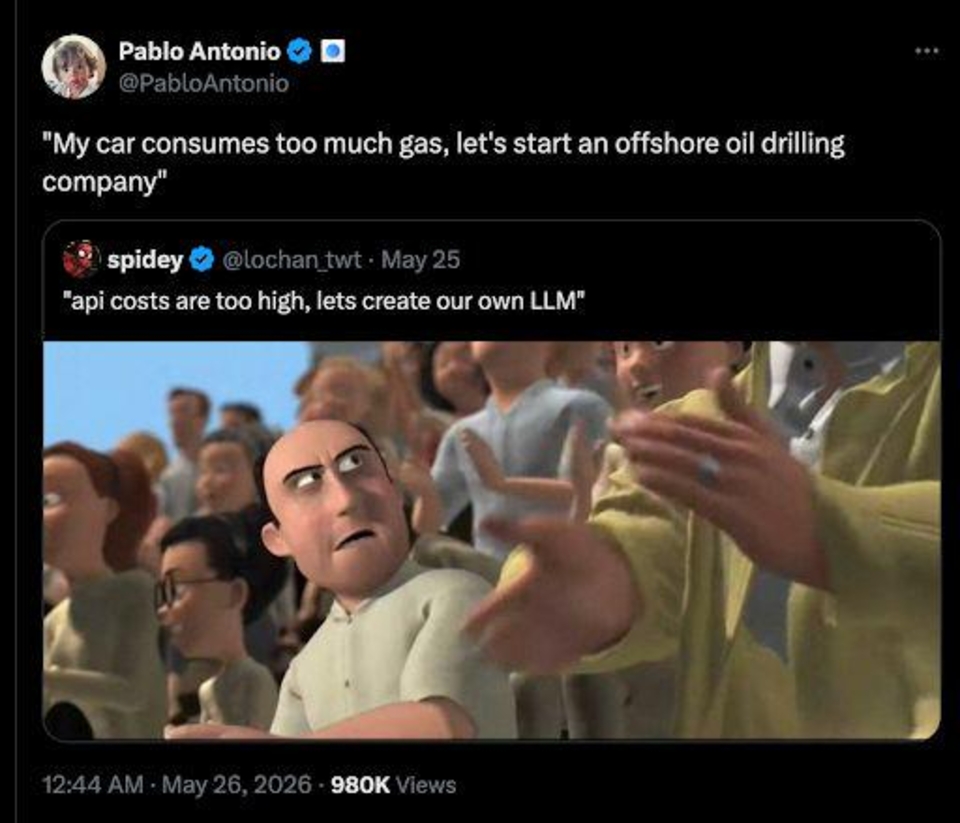
😂 Meme of the week


❤️ Thanks for reading
 
 
👋 Keep in touch and follow us on social media:
- 💼LinkedIn
- 📝Medium
- 🐦Twitter
- 👥Facebook
- 📰Reddit
- 📸Instagram

👌 Was this newsletter helpful?
We'd really appreciate it if you could forward it to your friends!

🙏 Never miss an issue!
To receive our future emails in your inbox, don't forget to add community@faun.dev to your contacts.

🤩 Want to sponsor our newsletter?
Reach out to us at sponsors@faun.dev and we'll get back to you as soon as possible.
 

SoftwareEngineeringLinks #522: Why I Vibe in Go, Not Rust or Python
Legend: ✅ = Editor's Choice / ♻️ = Old but Gold / ⭐ = Promoted / 🔰 = Beginner Friendly

You received this email because you are subscribed to FAUN.dev.
We (🐾) help developers (👣) learn and grow by keeping them up with what matters.

You can manage your subscription options here (recommended) or use the old way here (legacy). If you have any problem, read this or reply to this email.